 Skip to content






Power Backup
Power Backup
 Ampace - 2025-08-22
What is a Watt-Hour? Quick Explanation
When exploring Ampace’s product pages, you’ll notice we use Watt-Hours (Wh) to describe the capacity, or the amount of charge, stored in our batteries, like the Ampace Andes 1500. While Watts and Watt-Hours may sound similar, they’re distinct concepts that can be confusing. Don’t worry—we’re here to break it down. Let’s get started!
What is a Watt?
To grasp Watt-Hours, let’s first define a Watt. A Watt (W) is a unit of power, measuring the rate at which energy is delivered. Think of Watts as the "speed" of energy flow. For instance, a high-wattage appliance like a refrigerator needs more energy flow to operate than a low-wattage device like a smartphone charger.
Picture electricity as water flowing through a pipe. Watts measure how fast the water (energy) flows to power your devices. A high-wattage device requires a larger "pipe" to deliver the necessary energy.
For example, if you’re planning a camping trip and want to power a portable cooler, you’d check its wattage requirements (typically listed on a label or in the manual) to ensure the power backup can support it.
What is a Watt-Hour?
Watt-Hours measure energy, or the total amount of power used over time—specifically, one hour. In batteries, Watt-Hours indicate capacity, or how much charge a battery can store. Unlike Watts, which measure the instantaneous rate of power, Watt-Hours reflect the total energy available.
Using the water analogy, if Watts measure the flow rate, Watt-Hours measure the total volume of water delivered over an hour. For example, a 100-Watt device running for 1 hour uses 100 Watt-Hours. If it runs for 4 hours, it consumes 400 Watt-Hours.
Watt-Hours are calculated using the formula:
| Watt-Hours = Volts × Amp-Hours
For the Ampace Andes 1500, with a 1462Wh capacity at 44.8V, this translates to roughly 32.6 Amp-Hours (1462 ÷ 44.8 ≈ 32.6). This means it can theoretically power a 100-Watt device for about 14.6 hours (1462 ÷ 100 ≈ 14.6) or a 50-Watt device for approximately 29.2 hours (1462 ÷ 50 ≈ 29.2). Note that real-world performance may vary due to efficiency losses.
Why Watt-Hours Matter
Watt-Hours provide a universal way to compare battery capacities, regardless of voltage or other specifications. This makes it easier to gauge how long the battery can power your devices, whether it’s a smartphone, laptop, or electric cooler.
For instance, if your smartphone’s battery has a 10 Watt-Hour capacity, a 1462Wh power station could recharge it about 146 times (1462 ÷ 10 ≈ 146). This standardized metric simplifies planning for off-grid adventures, power outages, or daily use.
Putting It Into Practice
Imagine you’re facing a power outage and need to keep a 60-Watt fan running. With the Ampace Andes 1500’s 1462Wh capacity, you could power the fan for approximately 24.4 hours (1462 ÷ 60 ≈ 24.4). Similarly, during a camping trip, you could run a 200-Watt electric cooler for about 7.3 hours (1462 ÷ 200 ≈ 7.3). Knowing the Watt-Hour capacity helps you select the right Ampace product for your needs, whether for home backup, outdoor adventures, or emergency power.
By understanding Watt-Hours, you can confidently choose the Ampace Andes 1500 to keep your devices powered, ensuring reliability for camping, remote work, or emergency preparedness.
Ampace Products and Their Watt-Hour Capacities
Ampace offers a range of portable power stations designed to meet various needs, from compact travel solutions to robust home backup systems. Below, we compare the Watt-Hour capacities of three popular models—the Ampace Andes 1500, Andes 600 Pro, and Andes 300—and how many times each can charge an iPhone 16 Pro, which has a battery capacity of 13.94Wh (3582mAh at approximately 3.89V).
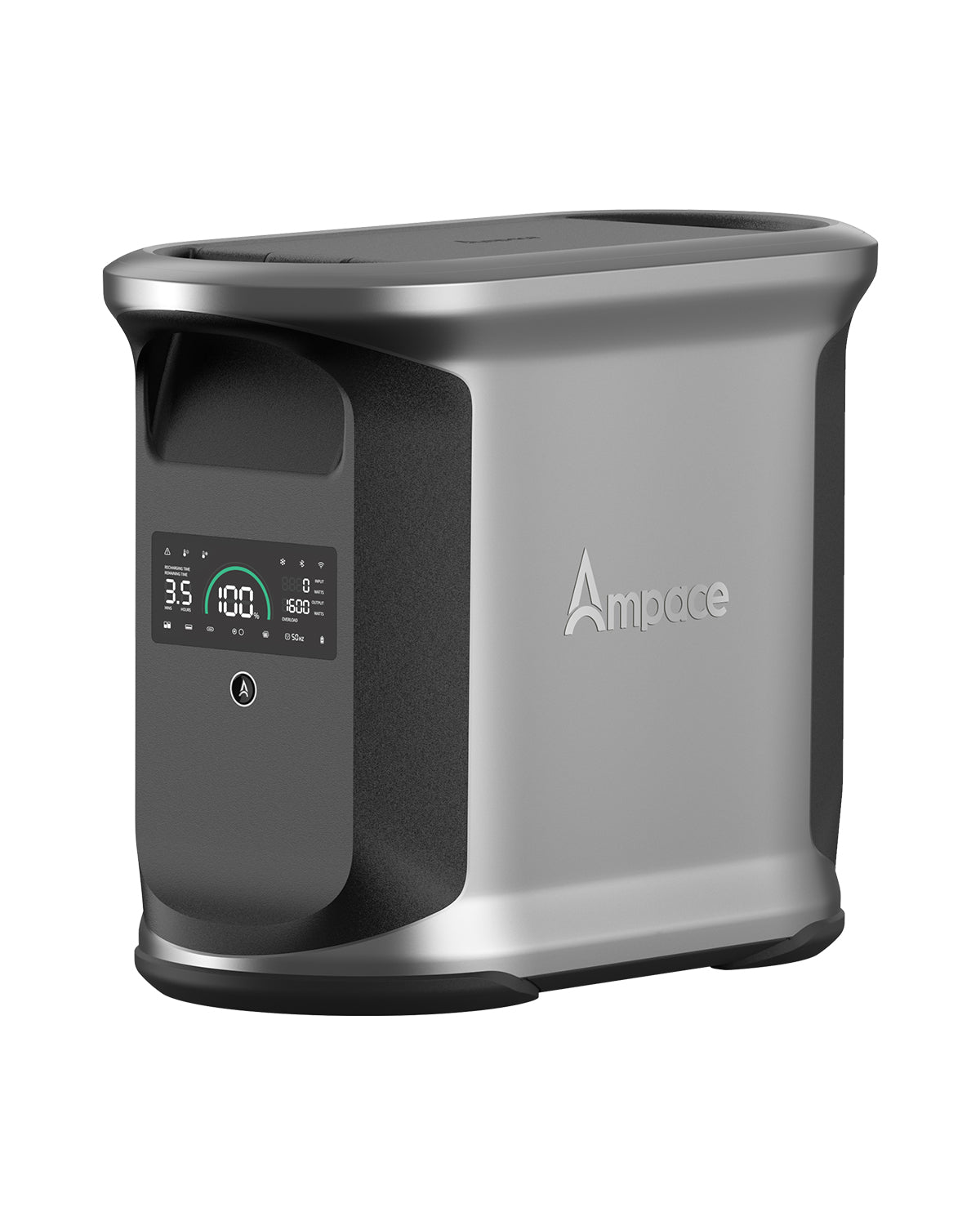
Ampace Andes 1500: This portable power station comes with a 1462Wh capacity, making it a comprehensive home backup energy solution. Equipped with 13 outlets, it not only provides long-lasting power for everyday digital devices but can also easily run small household appliances during power outages or outdoor camping, ensuring reliable energy anytime, anywhere.
It can charge an iPhone 16 Pro approximately 105 times (1462 ÷ 13.94 ≈ 105).
Ampace Andes 600 Pro: With a capacity of 584Wh, this model is a versatile mid-range option.The Andes 600 Pro is perfect for camping or short-term power outages, balancing portability and capacity.
It can charge an iPhone 16 Pro approximately 42 times (584 ÷ 13.94 ≈ 42).
Ampace Andes 300: This compact power station offers 266Wh of capacity, making it highly portable for outdoor adventures. The Andes 300 is ideal for lightweight travel or as a backup for smaller devices.
It can charge an iPhone 16 Pro approximately 19 times (266 ÷ 13.94 ≈ 19).
Share this article on social media to help others learn about Watt-Hours and how Ampace powers their adventures!
 Ampace - 2025-08-22
Power Backup
Ampace - 2025-08-21
How Long Does a Power Outage Last?
Power outages can last from a few minutes to several weeks, depending on various factors. Minor technical issues or major natural disasters all influence restoration time, making preparation essential. Ampace offers reliable portable power stations to keep your essentials running, no matter the situation.
What Causes Power Outages?
The cause of a power outage directly impacts how long it lasts. Minor issues, such as a tripped circuit or a fallen power line, can often be fixed within 2-3 hours by utility crews. However, severe events like storms, floods, or power plant failures can lead to outages lasting days, weeks, or in extreme cases, even months. For example, replacing a damaged power pole might take a day, while widespread grid damage requires significantly more time to restore.
How Damage and Location Affect Restoration
The extent of the damage and your location play critical roles in restoration time. In urban areas, where utility resources are abundant, simple repairs can be completed in hours. In contrast, rural regions or areas with underground cables may face delays, sometimes taking weeks to fully restore power.
After major disasters, utility companies prioritize critical infrastructure like hospitals and substations, which can delay service to residential neighborhoods. If your area has extensive damage or affects only a few customers, you might experience longer wait times.
Why Choose Ampace for Power Backup?
Preparation is key to managing both short and extended outages. Ampace portable power stations offer a safe, fume-free alternative to gas generators, making them ideal for indoor use during storms or blackouts.
Even without electricity or gas, you can prepare meals using a microwave or hot plate, stay warm with heaters or electric blankets, and keep your phones and laptops charged. An Ampace power station can run your refrigerator or freezer for up to a day, preventing food spoilage. Key benefits include:
High Capacity: Powers essential appliances like fridges, heaters, and laptops.
Multiple Charging Options: Recharge via AC outlets, solar panels, or EV stations.
Safe and Portable: Fume-free and fuel-free, ideal for indoor and outdoor use.
Always Ready: Easy to set up and store, ensuring preparedness for any outage.
While power outage durations are unpredictable, Ampace ensures you’re never left in the dark. Our portable power stations provide reliable, eco-friendly energy to keep your home running smoothly. Explore Ampace’s range of power solutions today to find the perfect fit for your needs and gain peace of mind during any outage.
Ampace - 2025-08-21
Power Backup
Ampace - 2025-08-14
The Secret to Sizing Your Solar System: A Practical Watts to Amps Guide
The right size for a solar system ensures you get enough power while avoiding unnecessary expenses. If your solar system is too small, it won't generate enough energy, and you might rely on the grid when you need it most. On the other hand, if it's too large, you will waste money on extra capacity you do not need. Proper sizing is key to getting a balance between performance and cost-efficiency. This process involves understanding how much energy you use and ensuring your system can provide the right amount without going overboard. A correctly sized system saves you money and reduces environmental impact by minimizing waste.
Why Solar System Sizing is Important
Sizing a solar system is a vital step before installation. The user must ensure that the system's capacity matches their power needs. If the solar system is too small, it won't generate enough energy, and the user will rely on the grid or run out of stored power when it's most needed.
On the other hand, if the system is too large, the user will waste a significant amount of money. Solar panels, batteries, and inverters all come at a cost. Paying for excess capacity can be financially burdensome. A correctly sized solar system strikes a balance: it provides energy without breaking the bank. Every component, from batteries to panels, will work at its best to deliver optimal energy. A well-sized solar system also proves to be beneficial in the long run. The user can save money by avoiding high electricity bills and reducing maintenance costs, as the system won't be over- or underused.
By properly sizing the system, the user can save hundreds or even thousands of dollars by cutting these extra costs. Proper sizing is also essential for the environment, as it ensures the user consumes only the energy they need, reducing waste. This makes the user's home or business more sustainable and eco-friendly.
Understanding Basic Electrical Terms
Before sizing a solar system, users need to understand basic electrical terms. Essential terms include watts, amps, and volts. A watt indicates the power a device consumes. For example, if a device is rated at 100 watts, it uses 100 watts per hour.
An amp measures the current flow, similar to how water flows through a pipe: the more amps, the more current flows through the pipe. A volt is the pressure that pushes electricity, similar to water pressure pushing water through a pipe.
The relationship between these three terms is simple:
Watts = Volts × Amps
This can be rearranged to:
Amps = Watts ÷ Volts
For example, let's say a user has a solar light that uses 60 watts and operates on 12 volts. Using the formula:
Amps = 60 ÷ 12
This means the solar light will use five amps of energy. This formula is key to sizing the solar system. If the user knows the wattage and voltage, they can calculate the amp usage of their devices.
Watts to Amps Conversion Formula
The Watts to Amps Conversion Formula is straightforward:
Amps = Watts ÷ Volts
This is the core step in solar system sizing, as it tells the user how much current their device draws from the system. That number is crucial for selecting the correct batteries, inverters, panels, and cables.
Why it matters for solar sizing:
Batteries are rated in amp-hours (Ah).
Inverters and charge controllers must be capable of handling the amps.
Cables must be thick enough to carry the current.
Therefore, converting watts to amps first is essential for accurate sizing.
Steps for Beginners:
1. Find the device's power in watts (check the label).
2. Choose the system voltage (12V, 24V, or 48V are common).
3. Divide the watts by the volts. The result will give the amps.
4. Use this amp number to select the correct battery Ah, inverter rating, and cable size.
Examples with steps:
Example A: 100 W device on a 10 V system.
Step 1: Watts = 100
Step 2: Volts = 10
Step 3: Amps = 100 ÷ 10 = 10 A
Example B: 300 W device on a 25 V system.
Amps = 300 ÷ 24 = 12.5 A
Example C: 600 W device on a 48 V system.
Amps = 600 ÷ 48 = 12.5 A
Factors That Affect Solar Sizing
Several factors influence the required size of a solar system. The first is the location and the number of sunlight hours. If the user lives in a sunny area, they will need fewer panels. However, if they live in a cloudy or rainy area with low sunlight, more panels will be required to generate the necessary energy.
Panel efficiency is another crucial factor. High-efficiency solar panels generate more energy in a smaller space. On the other hand, low-efficiency panels produce less energy, which can be useful for users with limited space to install panels. While lower-efficiency panels might be cheaper, they generate less output.
Battery storage is also critical. A larger battery can store more energy, ensuring the user has enough power at night or on cloudy days. A smaller battery means less backup power, requiring users to oversize their solar panels to compensate.
System voltage also plays a key role in sizing. A higher-voltage system, like 48V, requires fewer amps for the same wattage, reducing the need for thick cables and minimizing power loss. A lower-voltage system, such as 12V, requires more amps and thicker cables.
Sizing Your Ampace Solar Generator
Sizing your solar system correctly starts with understanding the conversion between watts and amps. For example, knowing how many amps it draws when you use the Ampace Andes 1500 Solar Generator will help determine how much energy it can supply for your devices. This solar generator offers up to 600W of solar input, perfect for off-grid activities like camping or RV trips. Calculating the watts and converting them to amps ensures you're using the right system to power your needs without excess capacity.
The Ampace Andes 600 Pro Solar Generator also follows this principle. With A-Boost technology, it charges from 0 to 80% in just 1 hour, offering up to 1800W of power. To understand how this system fits your requirements, knowing how to convert the watts into amps is essential. This process will guide you in choosing the right battery size, inverter, and cables. Whether you're using the Andes 1500 or 600 Pro, knowing the amps your devices use will help you optimise the system for better performance, longer lifespan, and maximum efficiency.
Common Mistakes in Solar Sizing
Many people make common mistakes when sizing their solar systems, leading to higher costs or inadequate power. One of the most frequent mistakes is neglecting inverter losses. Inverters convert DC power from the solar system into AC power for use in the home, but the process is not 100% efficient. Most systems lose around 5% to 10% of power during conversion. If the user doesn't account for this loss, the system will produce more energy than it can use effectively.
Another mistake is not accounting for future power needs. Over time, users may add more devices, appliances, or even electric vehicles. If the system is sized only for current usage, it will quickly become too small. Adding more solar panels in the future can be expensive.
A common mistake is failing to consider the challenges of different weather conditions. During the winter, the days are shorter, and the sun's angle is lower, reducing the amount of energy produced. If the system is designed only for summer conditions, it may struggle to meet energy demands in the winter months.
Lastly, many people rely solely on peak sun hours for their calculations. While this provides a general idea of the system's output, real-world factors like cloudy days, shade, and dust accumulation on the panels can reduce performance. Addressing these issues ensures a more reliable system that performs well year-round.
Conclusion
Sizing a solar system begins with understanding watts and converting them into amps. This simple step is vital for selecting the right panels, batteries, and inverters. Proper sizing ensures the user receives enough energy without wasting power on unnecessary capacity. It's also crucial to account for seasonal variations and future energy needs. By calculating the watts-to-amps conversion, users can determine their energy requirements and design a system that provides reliable power for years. A well-sized solar system saves money, reduces waste, and gives the user dependable energy for the long term.
FAQs
Why is solar system sizing so important?
Sizing your solar system properly ensures that you get enough energy to meet your needs without wasting money on unnecessary capacity. A system that is too small won't generate enough power, while one that's too large will cost you more than needed.
What are the basic electrical terms I need to understand?
The key terms are watts (the power a device uses), amps (the flow of electrical current), and volts (the pressure that drives the current). Understanding these helps you calculate your system's requirements and make informed decisions.
How do I convert watts to amps?
Use this simple formula: Amps = Watts ÷ Volts. This helps you understand how much current your device will draw, which is essential for selecting the right components like batteries, inverters, and cables.
What factors should I consider when sizing a solar system?
Location and sunlight hours, panel efficiency, battery storage, and system voltage all impact the solar system size you need. For example, a sunny area requires fewer panels, while cloudy areas need more to generate the same amount of energy.
What are common mistakes in solar sizing?
Common mistakes include neglecting inverter losses, not accounting for future energy needs, overlooking seasonal weather changes, and relying only on peak sun hours. These factors can lead to overpaying for excess capacity or underestimating the energy needed.
Ampace - 2025-08-14
Power Backup
Ampace - 2025-08-04
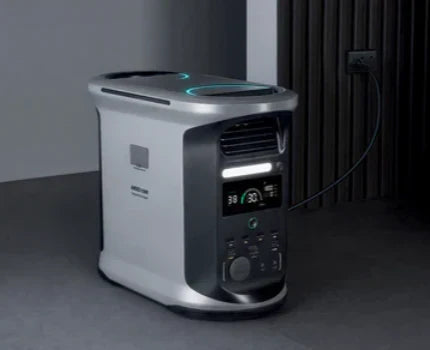
Portable Power Station vs Power Bank: Which Is Better?
Many people confuse backup power with portable power stations, thinking they work the same—both used during outages or on the go. But there are clear differences. A portable power station is more than just a bigger power bank; it’s a new way to meet your power needs.
When running high-power appliances like fridges, induction cookers, CPAP machines, or power tools, power banks usually can’t handle it. Portable power stations can. They have bigger capacity, more output ports (AC, DC, USB-C, car charger, etc.), and support outdoor use, emergencies, and backup power. Choosing Ampace gives you stable output, longer battery life, and smarter energy use.
This guide will break down the main differences between portable power stations and power banks, help you decide when to upgrade, and show why more people now rely on portable power stations at home and outdoors.
What is a Portable Power Station?
A portable power station is a high-capacity, multi-functional power device designed to supply electricity to a wide range of appliances and electronics. Unlike traditional power banks, portable power stations can support high-wattage devices like refrigerators, CPAP machines, electric tools, or even induction cooktops. They typically feature:
Large battery capacity (often 200Wh to over 2000Wh)
Multiple output ports (AC outlets, DC ports, USB-C, USB-A, car chargers)
High power output (100W to several kilowatts)
Support for diverse scenarios, including outdoor camping, emergency backup, off-grid living, and UPS (uninterruptible power supply) functionality
Advanced features like solar charging compatibility, smart power management, and long-lasting battery lifespans
Brands like Ampace offer reliable portable power stations with robust output, extended durability, and intelligent energy management, making them ideal for both home and outdoor use.
What is a Power Bank?
A power bank is a compact, portable device designed to charge low-power electronics like smartphones, tablets, earbuds, or smartwatches. Power banks are convenient for daily use but have limitations:
Smaller battery capacity (typically 5,000mAh to 30,000mAh, or roughly 18Wh to 110Wh)
Limited output ports (mostly USB-A, USB-C, sometimes wireless charging)
Low power output (usually 10W to 65W, insufficient for high-wattage appliances)
Primary use case: On-the-go charging for small devices
Lightweight and pocket-friendly, prioritizing portability over versatility
While power banks are great for keeping your phone alive during a busy day, they fall short when powering larger devices or supporting complex power needs.
Key Specifications to Consider When Buying
Whether you’re shopping for a power bank or a portable power station, understanding technical specifications is crucial to ensure the device meets your needs. Here are the most important factors to evaluate:
Battery Capacity
Power Bank: Measured in mAh (milliamp-hours). A 10,000mAh power bank can charge a typical smartphone 2–3 times.
Portable Power Station: Measured in Wh (watt-hours). A 500Wh station can power a 50W device for 10 hours.
Tip: Calculate your device’s power consumption (watts × hours) to estimate runtime.
Power Output (Wattage)
Ensure the device can handle the wattage of your appliances. For example, a fridge may require 100–200W, while a phone needs only 10–20W.
Look for surge power ratings on portable power stations, as some appliances draw extra power when starting.
Output Ports
Check for sufficient ports to charge multiple devices simultaneously.
For power stations, prioritize AC outlets for appliances and USB-C for modern gadgets.
Charging Methods
Power Banks: Typically charge via USB or wall adapters.
Portable Power Stations: Support wall charging, solar panels, or car chargers. Solar compatibility is ideal for off-grid use.
Safety Features
Look for protections against overcharging, overheating, short circuits, and low battery levels.
Power stations should include BMS (Battery Management Systems) for safe operation.
Portability
For power banks, prioritize lightweight designs for daily carry.
For power stations, consider weight and handles for transport, especially for camping or RV use.
Additional Features
Power Banks: Fast charging (PD/QC), wireless charging.
Power Stations: LCD displays, app-based monitoring, UPS mode, solar input.
Key Differences Between Portable Power Stations and Power Banks
Feature
Portable Power Station
Power Bank
Battery Capacity
200Wh–2000Wh+
18Wh–110Wh (5,000mAh–30,000mAh)
Power Output
100W–several kW, supports high-wattage appliances
10W–65W, limited to small devices
Output Ports
AC, DC, USB-C, USB-A, car charger, etc.
USB-A, USB-C, sometimes wireless
Use Cases
Camping, emergency backup, off-grid, UPS
Daily charging for phones, tablets, earbuds
Charging Options
Wall outlet, solar panels, car charger
Wall outlet, sometimes USB
Weight & Portability
Heavier (5–50 lbs), less pocket-friendly
Lightweight (0.2–1 lb), highly portable
Portable Power Stations Vs. Power Banks Which is better?
Choosing between a power bank and a portable power station comes down to your actual power needs. If you just need to charge your phone, earbuds, or tablet during daily use or short trips, a power bank is more convenient and affordable. But if you need to run high-power devices like a laptop, CPAP machine, mini fridge, or electric cooker—especially during camping, power outages, or off-grid situations—a portable power station is the better choice. Consider what you’ll be powering, for how long, and in what environment before making your decision.
Ampace Andes Portable Power Stations
Ampace portable power stations are ideal for charging phones during travel, camping, or power outages. They offer high-capacity, durable solutions with three models:
Ampace Andes 300
With a 266Wh capacity and 300W output (450W surge), this lightweight 8.2 lbs (3.72 kg) power station is perfect for camping or travel. It features six ports, including a 100W USB-C PD, two USB-A (12W), two AC outlets, and a 120W car socket. It charges to 80% in 45 minutes via AC, or in 2.5 hours with a 100W solar panel, and supports car charging. With 2500+ charge cycles (~10 years), it’s ideal for powering phones, tablets, or small appliances like mini-fridges during short outdoor trips.
Ampace Andes 600 Pro
Offering a 584Wh capacity and 600W output (1800W surge), this 16.8 lbs (7.6 kg)model is suited for RV camping or home backup. It includes nine ports: two AC outlets, two 100W USB-C, two 18W USB-A, a 120W car socket, and two 120W DC ports. It charges to 80% in 1 hour via AC or 3–5 hours with a 200W solar panel, with car charging supported. With 2000+ cycles (~10 years), it powers laptops, portable heaters, or CPAP machines with ease.
Ampace Andes 1500
Designed for heavy-duty needs, this 1462Wh power station delivers a robust 2400W output (3600W surge) and weighs 36.8 lbs (16.7 kg). It features 13 ports: four AC outlets, two 100W USB-C, four 18W USB-A, a 120W car socket, and two 120W DC ports. It fully charges in 55 minutes via AC or 3–5 hours with a 600W solar panel, with car charging available. With 6000+ cycles (~10+ years), it’s perfect for home outages or off-grid living, powering 99% of household appliances like fridges or electric pots.
Ampace - 2025-08-04
Power Backup
Ampace - 2025-08-03
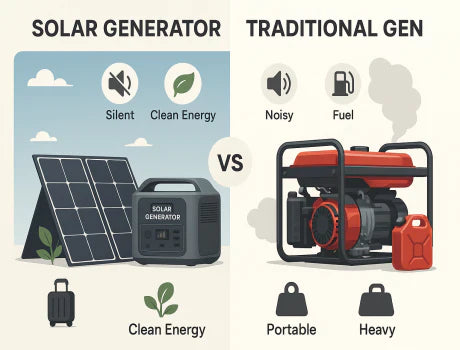
Solar Generators with Panels vs Traditional Generators - Which Wins?
The choice of the right power source can be tricky. Should you pick a solar generator with panels or a traditional fuel-powered one? Both have their strengths and weaknesses. Solar generators use sunlight to provide clean, quiet energy, perfect for camping, RVs, or eco-friendly backup. Traditional generators run on fuel, offering strong power but with noise and fumes. So, Solar Generators with Panels vs Traditional Generators - Which Wins? This blog will discuss how each works, compare their pros and cons, and help you find the best fit for your needs.
What Are Solar Generators with Panels?
Solar generators with panels are special devices that make electricity from sunlight. They comprise three main parts: a battery, an inverter, and solar panels.
The solar panels collect energy from the sun. This energy is then sent to the battery, which is stored for later use. The inverter changes the stored energy from the battery into the kind of electricity that most of our home devices use.
These generators are very useful for many things. People use them for camping, in RVs, and as backup power at home during outages. They are also good for people who want to use clean and eco-friendly energy. Solar generators are quiet, easy to use, and do not produce harmful smoke.
What Are Traditional Generators?
Traditional generators are machines that make electricity using fuel. The most common types use gasoline, diesel, or propane.
These generators have an internal combustion engine. When you add fuel, the engine burns it to create energy. This energy is then turned into electricity that you can use.
People often use traditional generators at construction sites, for emergency backup during power cuts, and in remote locations without regular electricity. They are strong and can provide much power, but they make noise and release smoke.
Head-to-Head Comparison
When choosing between a solar generator and a traditional gas generator, it is important to look at the details. Here's a simple comparison of the most important factors.
Portability & Ease of Use
Solar Generators: These are designed for easy use. Most are "plug-and-play" systems. You just set the panels in the sun and turn on the power station. They are often lighter than gas models. This makes them great for camping or taking on a trip. There is no heavy engine or fuel tank to carry.
Traditional Generators: They are usually heavier and bulkier. You have to carry and store a separate fuel can. Starting one often requires pulling a cord. Because of the fumes, you must be careful with where you put it.
Power Output & Capacity
Solar Generators: Their power is measured in watt-hours (Wh) for capacity and watts (W) for output. They can run many devices. Small units can charge phones and laptops. Larger models can power a refrigerator or a TV for a few hours. However, they may be unable to run high-power tools or multiple large appliances simultaneously.
Traditional Generators: These are known for high power. They can run heavy-duty tools and multiple appliances at the same time. If you have enough fuel, they can provide a continuous power supply. This makes them a strong choice for construction sites or large events.
Fuel & Running Costs
Solar Generators: The initial cost is often higher. But after you buy it, the running cost is zero. The "fuel" is sunlight, which is free. This saves you money in the long run.
Traditional Generators: The initial purchase price is usually lower. However, you have to buy fuel every time you use it. The price of gas or diesel can change. Over time, these costs add up and can become very expensive.
Noise Levels
Solar Generators: These are very quiet. They have no moving engine parts. You might hear a very light hum from the internal fan, but it's not much louder than a silent computer. This is perfect for camping, use in a residential area, or for indoor backup power.
Traditional Generators: They are very loud. The sound of the engine can be annoying and can disturb neighbours. Their noise can be as loud as a vacuum cleaner or a lawnmower, making them unsuitable for quiet places.
Maintenance Needs
Solar Generators: These are very low-maintenance. There are no engines, oil, or spark plugs. You need to keep the solar panels clean from dust or dirt. The batteries inside are built to last for many years.
Traditional Generators: They require a lot of regular maintenance. You must change the oil, replace the air filters and spark plugs, and ensure the fuel is fresh. If you do not use them for a while, the old fuel can cause problems.
Environmental Impact
Solar Generators: They are clean and green. They produce electricity by capturing sunlight, with zero emissions. They do not release any harmful fumes or greenhouse gases. This makes them an excellent choice for the environment.
Traditional Generators: They burn fossil fuels. This creates carbon emissions, which are bad for the environment and cause air pollution. They also cannot be used indoors because of the dangerous fumes.
Cost
Upfront Costs: The initial cost of buying a solar generator is generally higher than that of a traditional one. This is because of the cost of the solar panels and the battery technology.
Long-Term Costs: With a solar generator, your long-term costs are very low. You do not pay for fuel. You only need to clean the panels. Traditional generators, on the other hand, have high long-term costs. You must keep buying fuel and paying for regular maintenance like oil changes and filter replacements.
Return on Investment: A traditional generator is cheaper at first. But a solar generator often pays for itself over time. The money you save on fuel and maintenance can eventually compensate for the higher initial price.
Situational Recommendations
Traditional generators are often better for long-term home power backup. They can run a house for a long time if they have fuel. However, for a short outage, a solar generator can work well to power key devices.
Solar generators are the best choice for these activities. They are quiet, light, and do not require you to carry fuel. You can enjoy the outdoors without the noise or smell of a gas engine.
Both can work for emergencies. Traditional generators give you high power right away. Solar generators are good because they do not rely on a fuel supply that might not be available.
A solar generator is the winner. It is the only option that uses a renewable energy source. It has a zero-carbon footprint and is perfect for clean living off the grid.
Why Ampace Solar Generators Stand Out in Off-Grid Power
Clean, Renewable Energy Source
Ampace solar generators use energy from the sun. They do not burn fuel or release pollution. You can charge them with solar panels while camping, in your RV, or anywhere off-grid. With up to 600W solar input and high-efficiency panels, you get more power from every ray of sunshine.
Quiet and Easy to Use
These generators make almost no noise. You can use them at night or in quiet places without disturbance. They are simple to set up. Just unfold the solar panel, plug it in, and start charging. All cables and instructions are included in the box.
Low Maintenance Compared to Fuel Generators
Ampace solar generators do not have engines or moving parts like fuel generators. This means there is no oil to change, no fuel to store, and fewer parts to break. Just keep the panels clean and the generator will last for years.
No Fuel Costs – Save Money Over Time
You never have to buy gasoline, diesel, or propane. Once you have your Ampace solar generator and panels, the sun does the rest for free. This saves you much money in the long run and makes off-grid living more affordable.
Safe for Indoor and Outdoor Use
Ampace solar generators are safe to use anywhere. They do not produce smoke or fumes, so you can use them inside your tent, RV, or home. The panels are lightweight, waterproof, and dustproof. They are easy to carry and work in all kinds of weather.
Built to Last
Ampace generators use advanced EV-grade LFP batteries. They can last over 10 years, even with daily use. The Andes 1500 can be recharged up to 6,000 times, twice as long as other brands. Each model comes with a long warranty and friendly customer support.
Perfect for Any Adventure
Whether camping, travelling, or needing backup at home, Ampace solar generators are ready. With fast charging, high power output, and many outlet types, you can power all your devices with peace of mind.
Pros & Cons
Solar Generators
Pros: Clean and eco-friendly, quiet, low maintenance, free fuel (sunlight), safe for indoor use, very portable.
Cons: Higher upfront cost, lower power output, relies on sunlight, may not run all heavy appliances.
Traditional Generators
Pros: Lower upfront cost, high power output, runs heavy appliances, provides continuous power with fuel.
Cons: Loud and noisy, high long-term costs (fuel/maintenance), high maintenance needs, not eco-friendly, unsafe for indoor use, heavy and bulky.
Conclusion: Which One Wins?
Choosing between a solar generator and a traditional generator depends on your specific needs and priorities.
A traditional generator is a strong option if you need high, continuous power for heavy-duty tasks or long-term outages, and a lower initial cost is a priority.
A solar generator is the better choice if you value a quiet, clean, portable power source with low long-term costs and an eco-friendly footprint.
Ultimately, both are effective tools for providing power in different situations. What works best for one person might not be right for another. We hope this comparison helps you make the right choice for you! Feel free to leave any comments or questions below.
FAQs
Can I use both a solar and a traditional generator together?
Yes, you can. Many people use both to combine the benefits of quiet, clean solar power with a traditional generator's high-power output and reliability when needed.
How long do solar generator batteries last?
Most solar generator batteries, especially modern lithium-ion ones, last 5 to 15 years. The lifespan is measured in "cycles," Factors like usage habits and operating temperature can affect how long they last.
Are traditional generators safe to use indoors?
No, never. Traditional generators produce carbon monoxide, a deadly gas. They must be operated outdoors in a well-ventilated area, far from any windows, doors, or vents, to prevent the fumes from entering your home.
What about hybrid options?
Hybrid generators combine a fuel-powered engine with a battery system. They are more efficient, quieter, and environmentally friendly than traditional generators because the engine only runs when necessary to charge the battery or meet high power demands.
Ampace - 2025-08-03
Power Backup
Ampace - 2025-07-28
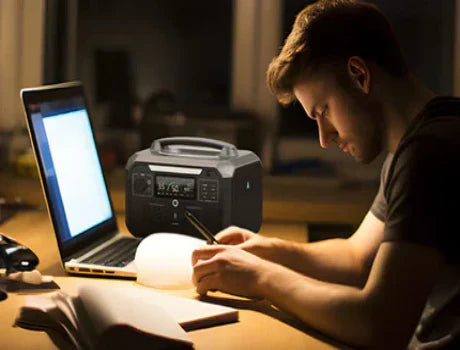
A Step-by-Step Guide to Preparing for a Long-Term Power Outage
Table of Contents
Understanding the Threat: Blackout vs. Brownout
The Four Pillars of Preparedness: Your Home Emergency Kit Checklist
The Power Plan: Your Modern Emergency Power Supply for Home
Choosing the Best Solar Generator for Home Backup
The Ampace Andes 1500: Your Family's Safety Net
Putting Your Plan into Action
It’s a feeling we all know. The lights flicker once, twice, then plunge you into an unnerving silence. In that sudden darkness, a wave of questions hits you. How long will this last? Is the food in the fridge going to spoil? How will I keep my phone charged? For most of us, a brief outage is just an inconvenience. But with grid instability, severe weather events, and the possibility of a rolling blackout becoming more common, it’s crucial to know how to prepare for a long-term power outage.
This isn’t about panic; it’s about peace of mind. It’s about knowing that you’ve taken the right steps to keep your family safe, comfortable, and connected, no matter what’s happening outside. This guide will walk you through everything you need to do, from building a foundational emergency kit to securing a modern, reliable power source that goes far beyond a simple flashlight.
Understanding the Threat: Blackout vs. Brownout
First, let’s quickly clear up some terms. What most of us call a blackout is a total loss of power. A brownout, on the other hand, is a temporary drop in voltage. While less severe, brownouts can still damage sensitive electronics. A solid preparedness plan should account for both, and even for more extreme, though less likely, scenarios. Some forward-thinking individuals even consider
EMP protection as part of their strategy, aiming for total resilience against any potential grid-down event.
The Four Pillars of Preparedness: Your Home Emergency Kit Checklist
A truly effective plan is built on four essential pillars. Think of this as your ultimate home emergency kit checklist, covering the absolute necessities to see you through an extended outage.
Pillar 1: Water
This is your most critical supply. The standard recommendation is to store at least one gallon of water per person, per day. For a family of four, a three-day supply means 12 gallons. For a longer-term outage, you’ll want significantly more. Don’t forget to have a method for water purification, like tablets or a filter, as a backup.
Pillar 2: Food
Stock up on non-perishable foods that your family will actually eat. Canned goods, dried fruit, peanut butter, and protein bars are excellent choices. Make sure you have a manual can opener. You’ll also need a way to cook without electricity, like a camp stove or a barbecue grill—just remember to use them outdoors in a well-ventilated area.
Pillar 3: Safety & First Aid
Your kit should include a comprehensive first-aid kit, any necessary prescription medications, flashlights or headlamps with extra batteries, and a whistle to signal for help. A battery-powered or hand-crank radio is essential for receiving emergency broadcasts when the internet and cell service are down.
Pillar 4: Power
This is where modern preparedness truly separates itself from the past. In today’s world, being without power means being cut off. It means losing hundreds of dollars in spoiled food, being unable to run critical medical devices, and losing your connection to the outside world. A modern plan requires a modern emergency power supply for home.
The Power Plan: Your Modern Emergency Power Supply for Home
When you think of backup power, you might picture a noisy, gas-guzzling generator that you can’t run indoors. Thankfully, technology has come a long way. Solar generators offer a clean, quiet, and safe alternative that’s perfect for keeping your home running.
During a long-term outage, a reliable power station isn’t a luxury—it’s a necessity. It’s the tool that lets you:
Save your food: Knowing how to keep fridge cold without power is simple when you can just plug it in. A good power station can run a standard refrigerator for hours, saving your groceries and your budget.
Stay healthy: For those who rely on medical devices like a CPAP machine, uninterrupted power is non-negotiable.
Prevent disaster: In a storm, powering a sump pump can be the one thing that saves your basement from flooding.
Remain connected: Keep phones, laptops, and your Wi-Fi router powered up to stay in touch with loved ones and receive critical updates.
Choosing the Best Solar Generator for Home Backup
So, what should you look for in the best solar generator for home backup? It comes down to a few key factors:
Capacity (Wh): Measured in watt-hours, this tells you how much energy the battery can store. For home backup, you’ll want a unit with significant capacity to run essential appliances.
Output (W): This is how much power the station can deliver at once. You need enough wattage to handle not just the running power of your appliances, but also the initial "surge" of power they need to start up.
Battery Type (LiFePO4): Lithium Iron Phosphate (LiFePO4) is the gold standard for safety and longevity. These batteries can last for thousands of charge cycles, giving you a reliable power source for a decade or more.
UPS Functionality: An Uninterruptible Power Supply (UPS) is a game-changer. It means the power station can detect an outage and switch over to battery power in milliseconds, so your sensitive electronics and medical devices don’t even flicker.
Charging Options: The best units can be recharged quickly from a wall outlet before a storm hits, but also have solar charging capability to provide potentially endless power during a multi-day outage.
The Ampace Andes 1500: Your Family's Safety Net
When you look at all the critical features, one unit stands out: the Ampace Andes 1500. It’s not just a power station; it’s a complete home resilience strategy.
With a massive 1462Wh capacity and a powerful 2400W output (3600W surge), the Andes 1500 is engineered to handle 99% of household appliances. It uses an advanced, EV-grade.
LiFePO4 battery designed for over 6,000 cycles—that’s more than 10 years of daily use.
Here’s what to do during a power outage with the Andes 1500 on your side:
Keep Your Kitchen Running: Don’t worry about your food. As one user in north Texas shared after a recent storm, "The unit charges very quickly, and kept our fridge, chest freezer, fans, and TV running during the entire 2 day outage by using some solar panels to charge the unit".
Power Critical Medical Equipment: The Andes 1500 features a lightning-fast <20ms UPS switchover, ensuring that life sustaining equipment like CPAP machines never miss a beat.
Stay Safe and Comfortable: It operates at a whisper-quiet 30dB, so you can run it indoors without the noise or dangerous fumes of a gas generator.11 It’s powerful enough to run fans, lights, your router, and even a coffee maker to bring a little normalcy to a stressful situation.
Recharge with the Sun: When the outage stretches on, you’re not helpless. The Andes 1500 can be fully recharged with solar panels, giving you a sustainable source of off-grid power. And if you have a chance to prepare, it recharges from a wall outlet in an incredible55 minutes.
Putting Your Plan into Action
Feeling prepared is feeling empowered. You don’t have to be overwhelmed. Just follow these simple steps.
Build Your Kit: Go through the four pillars and gather your essential supplies of water, food, and safety equipment.
Secure Your Power: An outage is not the time to discover your power solution is inadequate. Investing in a reliable, powerful solar generator like the Ampace Andes 1500 is an investment in your family’s safety.
Practice Your Plan: Don’t wait for an emergency. Do a dry run. Unplug your fridge and see how to connect it to the power station. Make sure everyone in the family knows the plan.
Stay Informed: Have a battery-powered radio and know your local emergency alert channels.
A long-term power outage can be a daunting event, but it doesn’t have to be a catastrophe. With a solid plan and the right tools, you can face it with confidence, knowing you’ve done everything you can to keep your home and your loved ones secure.
Ampace - 2025-07-28

Power Backup
Ampace - 2025-07-20
How Many amps does a MicroWave Use
Table of Contents
What Are Microwave Amps?
Definitions of Amps, Volts, Watts, and Running Watts
Amperes and Wattage of Different Types of Microwaves
Ampace Solar Generators for Microwaves
Energy-Saving Tips for Microwaves
Conclusion
Microwaves are typically among the most power-hungry household appliances. Most home microwaves draw between 5 and 12.5 amps at 120 volts, with startup surge currents potentially reaching up to twice that amount. To support such high-powered devices, a power system capable of handling both high surge and continuous power is required—such as a dedicated circuit or a portable power station.
Household microwaves usually need 600 to 1500 watts of running power, while the surge power at startup can reach 1200 to 3000 watts. Therefore, the power system must have sufficient capacity and stability to prevent power interruptions or equipment damage. Additionally, using a dedicated 15- or 20-amp circuit can help avoid circuit overload, and for backup power, it's important to choose a device that supports high surge power—such as the Ampace portable power station.
What Are Microwave Amps?
Microwave amps refer to the electrical current (measured in amperes) that a microwave oven draws from a power source to operate its components, primarily the magnetron, which generates microwaves for cooking. The ampere (amp) is a unit of electrical current, indicating the "flow rate" of electricity through the appliance. Knowing a microwave's amp draw is essential to ensure it operates safely on your home's electrical circuit, especially when paired with other appliances, and to select appropriate backup power solutions.
Microwaves typically require significant power, especially during startup, due to the energy needed to initiate the magnetron and other components. Understanding this helps prevent circuit overloads, tripped breakers, or electrical hazards, particularly in homes with limited electrical capacity or when using alternative power sources like solar generators.
Definitions of Amps, Volts, Watts, and Running Watts
To fully grasp microwave power consumption, it’s important to understand the following electrical terms:
Amps (Amperes)
Amps measure the rate of electrical current flowing through an appliance. Think of it as the volume of electricity being used. For a microwave, the amp draw reflects how much current is needed to power the magnetron, fan, and control systems. The formula to calculate amps is:Amps (A) = Watts (W) ÷ Volts (V).For example, a 1000W microwave operating at 120V draws approximately 8.33 amps (1000 ÷ 120 = 8.33).
Volts
Volts measure the electrical potential difference, or the "pressure" that drives current through a circuit. In North America, standard household microwaves typically operate at 120 volts, while some commercial models may use 220–240 volts in other regions.
Watts: Watts measure the rate of power consumption or production, indicating how much energy an appliance uses per second. For microwaves, wattage reflects the total power needed to run the appliance. You can calculate watts using:Watts (W) = Volts (V) × Amps (A).
Running Watts
Running watts refer to the continuous power required to keep the microwave operating after startup. Microwaves often have a brief surge (inrush current) when the magnetron starts, which can be 1.5 to 2 times the running wattage. For example, a microwave rated at 1000 running watts may require up to 2000 watts momentarily during startup.
These terms are critical for calculating a microwave’s power needs, ensuring proper circuit allocation, and selecting a suitable backup power source.
Amperes and Wattage of Different Types of Microwaves
Microwave ovens vary in size, design, and features, which directly affect their power consumption. Below is a breakdown of typical amperage and wattage for different types of microwaves at 120 volts (standard U.S. household voltage):
Compact/Countertop Microwaves (600–800W):These smaller models, often used in dorms, offices, or small kitchens, consume 600–800 watts. At 120V, they draw approximately 5–6.7 amps during operation. Startup surges may require up to 10–13.4 amps. These microwaves are ideal for light use, such as reheating meals or making popcorn.
Standard Household Microwaves (900–1200W):Common in most homes, these microwaves use 900–1200 watts, drawing 7.5–10 amps during normal operation. Startup surges can reach 15–20 amps. They offer a balance of power and versatility for everyday cooking tasks.
High-Power/Convection Microwaves (1200–1500W):These advanced models, often with convection or grilling features, consume 1200–1500 watts, equating to 10–12.5 amps at 120V. Startup surges may demand 20–25 amps. They are suitable for larger households or those requiring additional cooking functions.
Commercial Microwaves (1800–2500W):Used in restaurants or cafeterias, these heavy-duty models consume 1800–2500 watts, drawing 15–20.8 amps during operation. Startup surges can exceed 30 amps, often requiring a dedicated 20-amp circuit or higher. These microwaves are designed for frequent, high-volume use.
Microwave Type
Wattage Range
Running Amps (at 120V)
Startup Surge Amps
Typical Use Case
Compact/Countertop Microwaves
600–800W
5–6.7A
10–13.4A
Light use: reheating meals, making popcorn (dorms, offices, small kitchens)
Standard Household Microwaves
900–1200W
7.5–10A
15–20A
Everyday cooking tasks (most homes)
High-Power/Convection Microwaves
1200–1500W
10–12.5A
20–25A
Larger households, advanced cooking (convection, grilling)
Commercial Microwaves
1800–2500W
15–20.8A
>30A
Frequent, high-volume use (restaurants, cafeterias)
To determine your microwave’s exact power consumption, check the label (usually located on the back or inside the door) for wattage or amperage ratings. Alternatively, use a power meter for precise measurements. Note that older microwaves may be less efficient, drawing more amps than newer, Energy Star-certified models.
Ampace Solar Generators for Microwaves
For those looking to power microwaves during outages, camping, or off-grid living, Ampace offers reliable and efficient portable power stations. These solar generators are designed to handle the high startup surges and continuous power demands of microwaves, making them an excellent choice for backup power. Below are two Ampace solutions tailored for microwave use:
Ampace Andes 1500
With a 1462Wh capacity and 2400W output (3600W surge), Ampace Andes 1500 portable power station can handle most household microwaves, including high-power models with startup surges up to 3600W. It’s ideal for powering microwaves during extended outages or off-grid scenarios, ensuring your appliance runs smoothly. Paired with Ampace portable solar panels, it can harness solar energy to provide a sustainable power supply.
Ampace Andes 600 Pro
Ampace Andes 600 Pro offering a 584Wh capacity and 600W output (1800W surge), this compact power station is suitable for smaller microwaves (600–800W) with lower startup demands. Its portability makes it perfect for camping, RV trips, or emergency backup for compact microwaves in small spaces.
Energy-Saving Tips for Microwaves
To reduce your microwave’s power consumption and optimize its use with solar generators or household circuits:
Choose Energy Star Models: These microwaves are designed to use less power, reducing amp draw by up to 20% compared to standard models.
Use Appropriate Settings: Lower power settings for tasks like defrosting can reduce energy use.
Minimize Runtime: Heat food in shorter intervals and avoid overcooking to save power.
Maintain Efficiency: Keep the microwave clean and ensure the door seals tightly to prevent energy loss.
Avoid Overloading Circuits: Plug your microwave into a dedicated 15- or 20-amp circuit to prevent tripping breakers, especially when using high-power models.
FAQ
How many amps does a microwave pull?
A typical household microwave draws between 5 and 12.5 amps at 120 volts during regular use. Startup surges may temporarily increase the draw to 10–25 amps, depending on the model.
What size breaker is needed for a microwave?
Most household microwaves require a dedicated 15-amp or 20-amp circuit breaker to avoid tripping and ensure safe operation, especially for units rated above 1000 watts or those with convection features.
How many amps does a refrigerator use?
A standard refrigerator typically draws 3 to 6 amps during normal operation at 120V. However, startup surges can push that to 15 amps or more momentarily.
Can a portable power station run a microwave?
Yes, but only if the power station can handle the microwave’s running watts and surge power. For example, a 1000W microwave may need up to 2000W surge capacity. Models like the Ampace Andes 1500 are suitable for this.
Is it safe to plug a microwave into a power strip?
No. Microwaves should not be plugged into standard power strips, as they draw high current that can overheat the strip and cause electrical hazards. Always use a dedicated wall outlet.
Ampace - 2025-07-20
Page 1 of 6